Yesterday’s storms had blown through, and Sunday morning in Regent’s Park brought sunshine and a stiff breeze. I joined the Longevity Cities London Matcha & Walk starting in Marylebone: a drink to go, a short intro on matcha followed by a walk1.
I’ll admit the matcha craze has largely passed me by. I knew of the health claims, but had never stood in one of those (often bright green!) shops myself. Clearly I’m in the minority: in May the BBC reported more than 14 million posts tagged #matcha across Instagram and TikTok2.
Matcha studies
Matcha is powdered whole green tea leaf, so you drink the leaf itself rather than an infusion. It contains catechins (a ployphenol – notably EGCG), L-theanine and caffeine.
L-theanine (relaxing) and caffeine (stimulating) combined in matcha seem to balance each other out, hence its use to help sustained focus.
A 2022 review found human trials suggest matcha may lower stress and slightly improve attention and memory; heart and metabolic benefits have so far been shown mainly in animals3. A quick look at more research on this phenomenon brought up:
- In older adults with mild cognitive decline, 2g a day for a year did not change the main memory scores, though emotional perception improved and sleep showed a trend towards improvement4;
- In healthy adults, about 2.7g a day for four weeks did not change measured sleep, but people felt more satisfied with it5; and
- Fittingly for a walking group, a small study found matcha modestly increased fat burning during a 30-minute brisk walk6.
It is worth mentioning that some of these trials were part-funded by tea companies. It is also worth mentioning that polyphenols are found in green tea too. And green tea is an awful lot cheaper that good quality matcha.
Caffeine load and beyond
Matcha contains around 70 mg of caffeine in a 2.7g serving5, so take care if you are sensitive to it, pregnant, or also drinking coffee. The European Food Safety Authority considers green tea drinks generally safe, but concentrated green tea extract supplements providing 800 mg or more of EGCG a day have been linked to early signs of liver strain7. And a sweetened latte is a different proposition from matcha whisked in water
My take away
While polyphenols are beneficial, potentially part of the wider benefits of matcha come from the ritual associated with drinking it. So, aligned with that, I suspect the walk, the outdoor air and the conversation were doing at least as much good as the drink.
References
- Longevity Cities. About Longevity Germany [Internet]. Munich: Longevity Cities; 2026 [cited 2026 Oct 25]. Available from: https://longevity-germany.com/en/about
- Bull B. Is matcha actually healthy? Here’s what the science says [Internet]. London: BBC; 2026 May 11 [cited 2026 Oct 25]. Available from: https://www.bbc.co.uk/food/articles/clyxegk1k7xo
- Sokary S, Al-Asmakh M, Zakaria Z, Bawadi H. The therapeutic potential of matcha tea: a critical review on human and animal studies. Curr Res Food Sci. 2022;6:100396. doi:10.1016/j.crfs.2022.11.015
- Uchida K, Meno K, Korenaga T, Liu S, Suzuki H, Baba Y, et al. Effect of matcha green tea on cognitive functions and sleep quality in older adults with cognitive decline: a randomized controlled study over 12 months. PLoS One. 2024;19(8):e0309287. doi:10.1371/journal.pone.0309287
- Baba Y, Takihara T, Okamura N. Matcha does not affect electroencephalography during sleep but may enhance mental well-being: a randomized placebo-controlled clinical trial. Nutrients. 2024;16(17):2907. doi:10.3390/nu16172907
- Willems MET, Şahin MA, Cook MD. Matcha green tea drinks enhance fat oxidation during brisk walking in females. Int J Sport Nutr Exerc Metab. 2018;28(5):536-41. doi:10.1123/ijsnem.2017-0237
- EFSA Panel on Food Additives and Nutrient Sources added to Food (ANS), Younes M, Aggett P, Aguilar F, Crebelli R, Dusemund B, et al. Scientific opinion on the safety of green tea catechins. EFSA J. 2018;16(4):5239. doi:10.2903/j.efsa.2018.5239
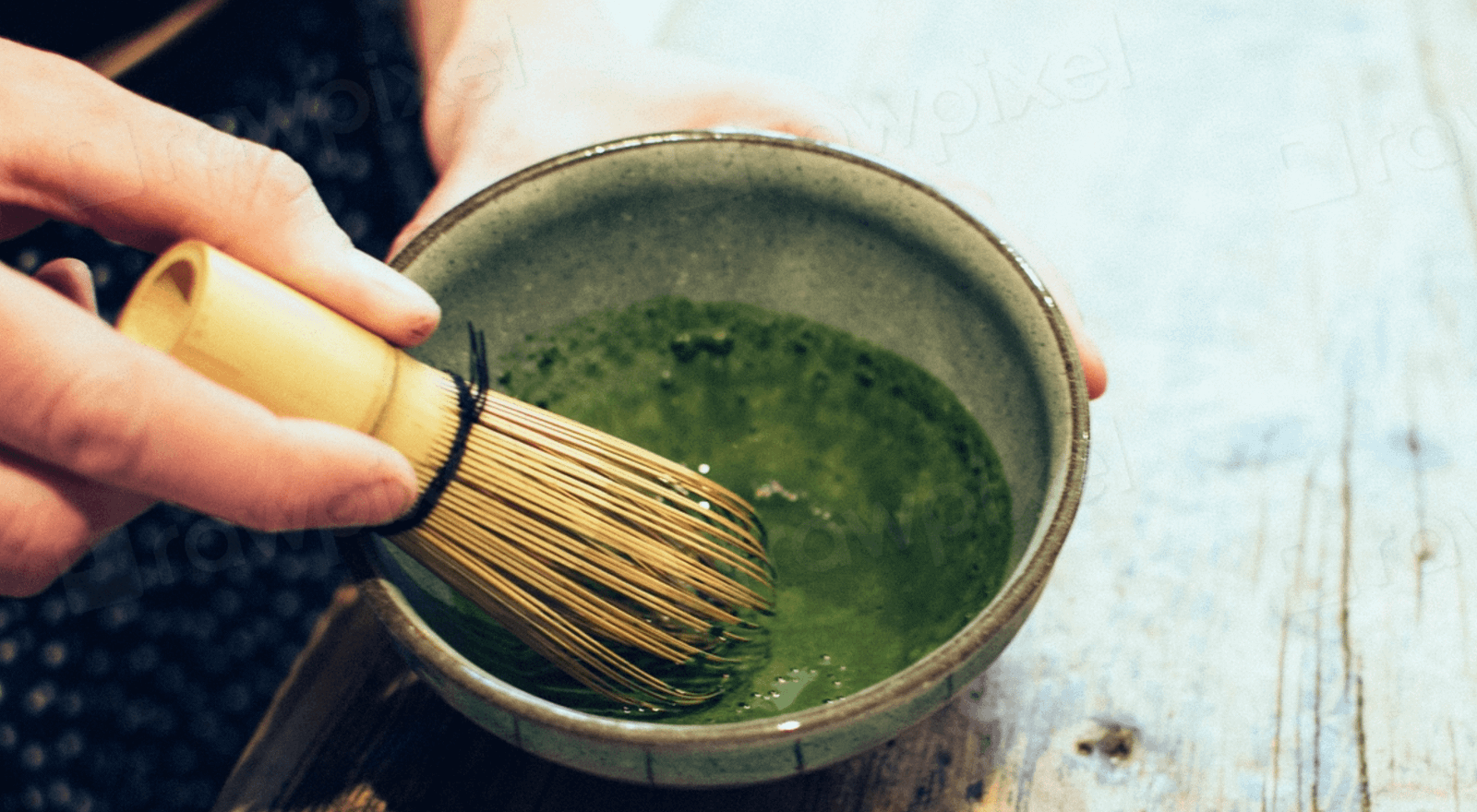
Image: Hand whisking a Matcha tea, Jakub Kapusnak via Rawpixel, CC0 1.0 Universal