Summary
- Human sperm counts have been falling for decades, along with fertility rates.
- Specific foods and nutrients could improve sperm parameters more than a general healthy diet.
- These include nutrients and phytochemicals such as folate, selenium, zinc, omega-3 fatty acids, and lycopene.
Concern about falling sperm counts and fertility levels has been around for decades. A large 2017 analysis of 185 studies and almost 43,000 men found that sperm concentration among Western men from the general population fell by more than half between 1973 and 2011, with no sign of levelling off1,2. No significant trend was seen in other regions, although this was potentially due to scarcer data1. The analysis could not say why, but diet is among the lifestyle factors that researchers have linked to sperm count1.

So can what we eat make a difference? A recent randomised trial offers a potential, affirmative answer.
What the researchers did
Researchers in Iran recruited 68 men with idiopathic infertility, meaning no clear cause had been found for the quality of their semen3. For 12 weeks, half followed a ‘fertility diet’, while the rest followed a general healthy diet with a similar balance of protein, fat and carbohydrate3,4.
The fertility diet focused on plant-based proteins and included cashews, walnuts, chia seeds, saffron, kombucha, and vitamin C-rich fruit such as strawberries and kiwi. The comparison group had no specific food advice, just broad goals such as five to nine portions of fruit and vegetables a day4.
What they found
The fertility diet group saw greater improvements in total sperm count, sperm concentration, motility (how well sperm move) and morphology (the proportion of normally shaped sperm)3. They also showed lower sperm DNA fragmentation, a measure of damaged genetic material, and lower malondialdehyde, a marker of oxidative stress3.
This group ate more omega-3 fats, fibre, zinc, selenium, vitamin C and lycopene, the red pigment in tomatoes3. These are all nutrients thought to support sperm health, which may help explain the results3. Many of them are antioxidants, which help protect sperm from the cell damage that oxidative stress can cause.
Keeping it in perspective
This was a small trial, run in one country over a short period, and the authors do call for larger and longer studies3. It also measured semen parameters rather than pregnancies or live births, and sex hormone levels and body measurements did not differ between the groups3.
Practical takeaways
No suggestions here are too exotic. Think colourful fruit and vegetables, nuts and seeds, and more plant-based protein, eaten consistently over a few months. The trial tested a dietary pattern, so a broad intake of the above-mentioned beneficial nutrients is advisable.
Various herbal preparations can help improve sperm quality and quantity, but that is for another post …
References
- Levine H, Jørgensen N, Martino-Andrade A, Mendiola J, Weksler-Derri D, Mindlis I, et al. Temporal trends in sperm count: a systematic review and meta-regression analysis. Hum Reprod Update. 2017;23(6):646-59. doi:10.1093/humupd/dmx022
- Trilling D. American men have half the sperm they used to [Internet]. The Journalist’s Resource; 2017 Aug 4 [cited 2026 Oct 1]. Available from: https://journalistsresource.org/environment/sperm-count-falling-developed-world/
- Honarkar-Shafie E, Taheri F, Hosseinzadeh E, Okhovat AR, Ashrafi Saadat SS, Goudarzi R, et al. Impact of a fertility diet on male reproductive function: a 12-week randomized clinical trial in idiopathic infertility patients. Int J Fertil Steril. 2026 Jul 27. PMID: 42571062. doi:10.22074/ijfs.2025.2059560.1874
- Examine. A diet designed to improve sperm parameters did just that [Internet]. Examine; 2026 Sep 16 [cited 2026 Oct 1]. Available from: https://examine.com/research-feed/study/0e86z1/?
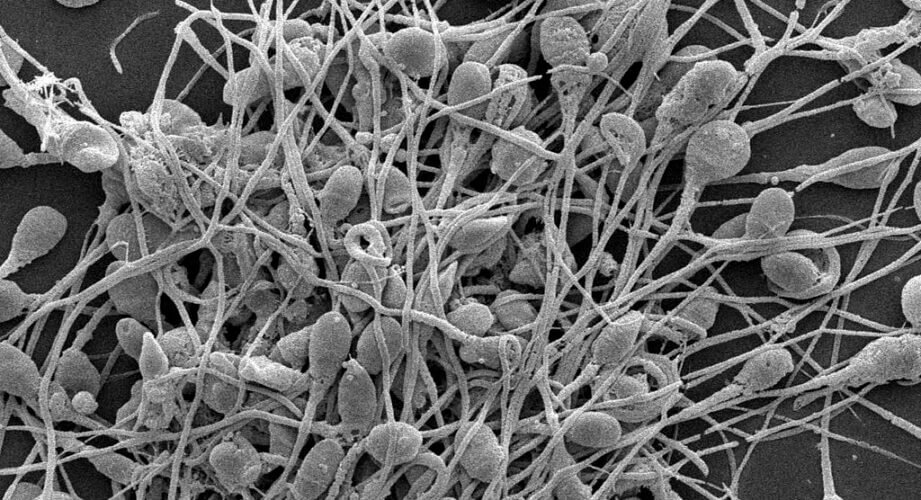
Header image: Human sperm magnified 2,500 times. Enver Kerem Dirican, Wikimedia, used under Creative Commons license BY-SA 4.0
Body image: A sperm cell fertilising an egg cell. Public domain, via Wikimedia Commons