Summary
- HPA axis/stress: Ashwagandha can regulate the stress-response pathway; trials show consistent cortisol reduction in stressed adults, even with short courses.
- Thyroid: An 8-week RCT showed normalisation of TSH, T3 and T4 in subclinical hypothyroid patients.
- Reproductive hormones: Improves sperm count/motility/volume in men; improves FSFI/FSDS scores in women.
- Blood sugar/metabolic: Evidence for improved insulin sensitivity, HbA1c, and lipid markers — but human trial evidence is still limited.
- Caveats: Not a cure-all; can overstimulate some people; avoid in late pregnancy, nightshade sensitivity, and with thyroid meds without practitioner supervision.
Ashwagandha for endocrine support
Ashwagandha (Withania somnifera) has featured in Ayurvedic medicine for around 4,000 years. Its name derives from the Sanskrit ashva (horse) and gandha (smell), referring to the root odour, and ‘somnifera’ relates to its sedative properties1. Ashwagandha has become a very popular herb in the UK and it is used to treat a wide range of conditions, but this is a brief overview of some of its actions on the endocrine system.
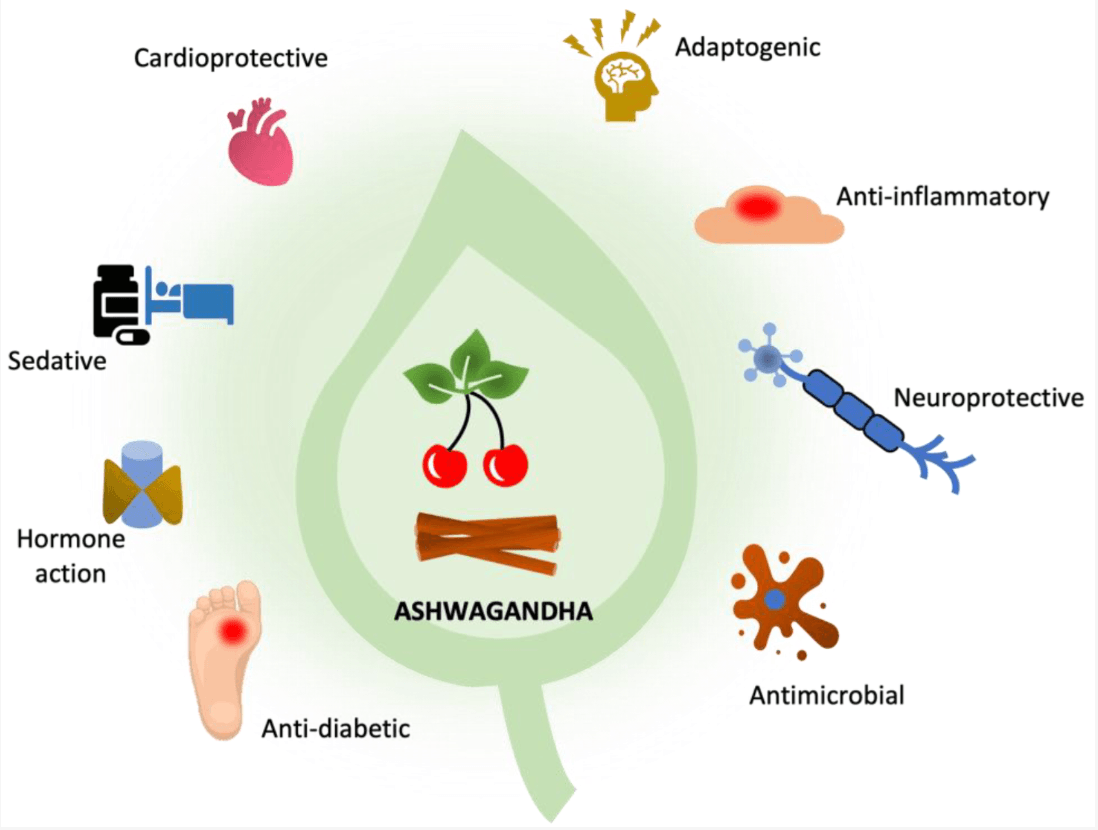
The endocrine system is the body’s network of glands such as the thyroid, adrenals, pituitary, ovaries/testes and pancreas, that produce and release hormones directly into the bloodstream. These hormones act as chemical messengers, regulating body functions including metabolism, growth, stress response, reproduction, and mood. They work more slowly than the nervous system, but with widespread, longer-lasting effects. Generally, ashwagandha’s many actions and indications relate to, and affect the endocrine system in a variety of ways2, as indicted in the diagram below.
Adaptogenic and sedative actions
Ashwagandha appears to help regulate the hypothalamic-pituitary-adrenal (HPA) axis, the body’s central stress-response pathway, and to support normal adrenal activity during burnout or chronic fatigue3,4. A systematic review of human trials found consistent reductions in cortisol among stressed adults taking the herb5, and even brief courses of supplementation appear to have a stress-reducing effect6. Ashwagandha’s adaptogenic properties are likely due to the complex of steroidal withanolides in the root7, which have antioxidant and immune system-activating effects along with the plant’s phenolic compounds and alkaloids3.
Rebalancing thyroid function
Ashwagandha has been shown to affect thyroid health. In a randomised, placebo-controlled trial, eight weeks of ashwagandha root extract significantly improved thyroid secretory function, significantly normalising thyroid indices (thyroid stimulating hormone (TSH), T3 and T4) in adults with subclinical hypothyroidism, compared with placebo8.
Supporting reproductive hormones
Ashwagandha has demonstrated measurable benefits for reproductive health in randomised, placebo-controlled human trials. Its role as a reproductive tonic also has an endocrine basis, with research pointing to improved reproductive hormone balance and function3. In men, ashwagandha has been shown to improve sperm count, motility, and semen volume alongside favourable shifts in reproductive hormones. In women, significant gains have been reported in Female Sexual Function Index scores relative to placebo, assessing outcomes via the FSFI and FSDS questionnaires and the number of successful sexual encounters9,10,11.
Diabetes and metabolic syndrome
Increasing evidence suggests ashwagandha may support blood glucose management in diabetes and management of metabolic syndrome. In vitro work has shown that ashwagandha extracts can increase insulin secretion and improve insulin sensitivity in muscle cells12, and a broader phytochemical review notes hypoglycaemic effects reported across several studies13. A 2020 systematic review and meta-analysis of in vitro, pre-clinical, and clinical studies, found that ashwagandha significantly improved blood glucose, HbA1c, insulin, and lipid markers with no major safety concerns14. More broadly, ashwagandha has been found to alleviate the symptoms of metabolic syndrome15, however all studies caveat that more research is needed, particularly human trials. Therefore, ashwagandha should be discussed with, not substituted for, an existing diabetes management plan.
No cure-all
This has been a very focused, simplified look at ashwagandha in relation to the endocrine system. While this plant has many proven benefits, it is certainly not a cure-all and in some cases and for some people, it is not an appropriate herbal remedy. The use of adaptogenic herbs should be closely monitored and they are not a substitute for lifestyle changes. Ashwagandha may stimulate some people, rather than calm; it should be avoided before pregnancy late stages and used under practitioner supervision. Ashwagandha should be avoided in solanaceae (nightshade) family sensitivity and not taken alongside thyroid medications without practitioner supervision16,17.
References
- Williamson EM. Potter’s herbal cyclopaedia. London: The C.W. Daniel Company; 2003.
- Mikulska P, Malinowska M, Ignacyk M, Szustowski P, Nowak J, Pesta K, et al. Ashwagandha (Withania somnifera) — current research on the health-promoting activities: a narrative review. Pharmaceutics. 2023;15(4):1057.
- Wiciński M, Fajkiel-Madajczyk A, Kurant Z, Kurant D, Gryczka K, Falkowski M, et al. Can ashwagandha benefit the endocrine system? A review. Int J Mol Sci. 2023;24(22):16513.
- Lord R. Clinical herbalism: plant wisdom from east and west. London: Elsevier; 2022.
- Della Porta M, Maier JA, Cazzola R. Effects of Withania somnifera on cortisol levels in stressed human subjects: a systematic review. Nutrients. 2023;15(24):5015.
- Pandit S, Srivastav AK, Sur TK, Chaudhuri S, Wang Y, Biswas TK. Effects of Withania somnifera extract in chronically stressed adults: a randomized controlled trial. Nutrients. 2024;16(9):1293.
- Bone K, Mills S. Principles and practice of phytotherapy. 2nd ed.London: Churchill Livingston Elsevier; 2013.
- Sharma AK, Basu I, Singh S. Efficacy and safety of ashwagandha root extract in subclinical hypothyroid patients: a double-blind, randomized placebo-controlled trial. J Altern Complement Med. 2018;24(3):243-8.
- Ambiye VR, Langade D, Dongre S, Aptikar P, Kulkarni M, Dongre A. Clinical evaluation of the spermatogenic activity of the root extract of ashwagandha (Withania somnifera) in oligospermic males: a pilot study. Evid Based Complement Alternat Med. 2013;2013:571420.
- Ajgaonkar A, Jain M, Debnath K. Efficacy and safety of ashwagandha (Withania somnifera) root extract for improvement of sexual health in healthy women: a prospective, randomized, placebo-controlled study. Cureus. 2022;14(10):e30787.
- Dongre S, Langade D, Bhattacharyya S. Efficacy and safety of ashwagandha (Withania somnifera) root extract in improving sexual function in women: a pilot study. Biomed Res Int. 2015;2015:284154.
- Gorelick J, Rosenberg R, Smotrich A, Hanuš L, Bernstein N. Hypoglycemic activity of withanolides and elicitated Withania somnifera. Phytochemistry. 2015 Aug;116:283–9.
- Saleem S, Muhammad G, Hussain MA, Altaf M, Bukhari SNA. Withania somnifera L.: insights into the phytochemical profile, therapeutic potential, clinical trials, and future prospective. Iran J Basic Med Sci. 2020 Dec;23(12):1501–26.
- Durg S, Bavage S, Shivaram SB. Withania somnifera (Indian ginseng) in diabetes mellitus: a systematic review and meta-analysis of scientific evidence from experimental research to clinical application. Phytother Res. 2020 May;34(5):1041–59.
- Azimi E, Rameshrad M, Ghasemzadeh Rahbardar M, Hosseinzadeh H. Ashwagandha (Withania somnifera) in insulin resistance and metabolic syndrome: A literature review on mechanisms. Iran J Basic Med Sci. 2026;29(1):3–21. doi:10.22038/ijbms.2025.86747.18741 PubMed PMID: 41641144; PubMed Central PMCID: PMC12867099.
- Thomsen M. The phytotherapy desk reference. 6th ed. London: Aeon Books; 2022.
- McIntyre A. Boudin M. Dispensing with tradition: A practitioner’s guide to using Indian and western herbs the ayurvedic way. Cheltenham: McIntyre & Boudin; 2012.
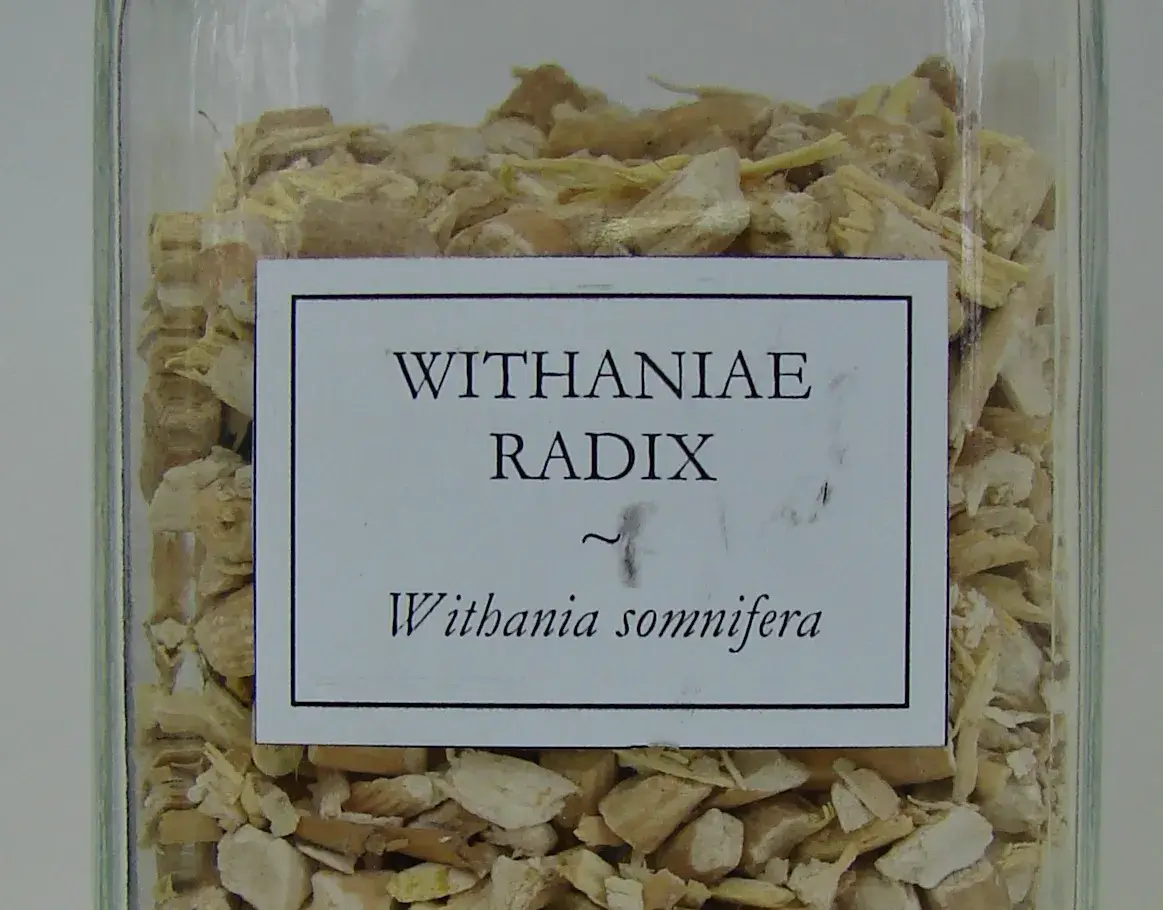
Image: Withania somnifera by Maša Sinreih in Valentina Vivod CC BY-SA 3.0
Diagram: Mikulska et al. 2023. The comprehensive health benefit of Ashwagandha. CC BY 4.0.