Summary
- Willow bark is a traditional source of salicylic acid (the source of aspirin), used for pain relief for over 3,500 years.
- Willow is gentler on the stomach than aspirin, offers longer-lasting pain relief, and does not have the bleeding risk of aspirin.
- The whole herb works better than isolated salicin, due to its combined salicylate compounds, providing anti-inflammatory and analgesic effects.
- Avoid if you have bleeding disorders, salicylate sensitivity, or are pregnant/breastfeeding.
Willow bark (Salix spp.) has been used to ease pain for over 3,500 years1. It is, along with meadowsweet (Filipendula ulmaria), an original source of salicylic acid, the compound synthesised into aspirin. Compared to aspirin, however, willow tends to be far gentler on the stomach2. Its active analgesic compounds also stay in circulation for longer than aspirin, without the same increased risk of bleeding3.
Whole herb action
Willow bark’s range of salicylate compounds appear to work best together, providing combined anti-inflammatory and analgesic effects4. Research points to the whole herb, rather than isolated salicin, being needed for full therapeutic benefit5,6. While white willow (Salix alba) is often used, other varieties contain different amounts of salicin. For example, crack willow (Salix fragilis) contains higher salicin levels than white willow7.
Easing arthritis, gout and back pain
In herbal tradition, white willow is valued for clearing the excess heat associated with arthritis, gout, connective tissue inflammation and general muscle pain, particularly when paired with celery seed8. Reviews looking at chronic lower back pain have found encouraging, if not entirely conclusive, results9, while a more recent meta-analysis of randomised controlled trials found significant reductions in pain and meaningful improvements in overall health for people with various forms of arthritis10. Those with osteoarthritis or rheumatoid arthritis may need higher doses to see the full benefit5.
Taking willow bark safely
Because of its tannin content, willow bark is better taken with food, which helps bind the tannins and avoid any stomach irritation11. It doesn’t have to be taken internally, though: infused oils, salves, poultices and baths made from the bark can be used to soothe aching muscles and joints directly12.
Cautions include bleeding disorders, sensitivity to salicylates and use during pregnancy and breastfeeding as salicylates in breast milk may cause baby macular rashes. As with any herbal remedy, it is advisable to check suitability with a qualified herbal practitioner, especially if you take other medication or have an underlying health condition.
References
- Montinari MR, Minelli S, De Caterina R. The first 3500 years of aspirin history from its roots – a concise summary. Vasc Pharmacol. 2019;113:1-8.
- Taylor S. The humoral herbal. London: Aeon Books; 2021.
- Balch PA, Bell S. Prescription for herbal healing. 2nd ed. New York: Penguin; 2012.
- Antoniadou K, Herz C, Le NP, et al. Identification of salicylates in willow bark (Salix cortex) for targeting peripheral inflammation. Int J Mol Sci. 2021;22(20).
- Dragos D, Gilca M, Gaman L, et al. Phytomedicine in joint disorders. Nutrients. 2017;9(1):70.
- Williamson EM. Potter’s herbal cyclopaedia. Saffron Walden: The C.W. Daniel Company; 2003.
- Bruton-Seal J, Seal M, Parkinson J. The herbalist’s bible. Ludlow: Merlin Unwin Books; 2021.
- Hedley C, Shaw N. Plant medicine. London: Aeon; 2023.
- Oltean H, Robbins C, van Tulder MW, Berman BM, Bombardier C, Gagnier JJ. Herbal medicine for low-back pain. Cochrane Database Syst Rev. 2014;2014(12):CD004504.
- Lin CR, Tsai SH, Wang C, Lee CL, Hung SW, Ting YT, Hung YC. Willow bark (Salix spp.) used for pain relief in arthritis: a meta-analysis of randomized controlled trials. Life. 2023;13(10).
- Bone K. Functional herbal therapy. London: Aeon Books; 2021.
- Kress H. Practical herbs 2. London: Aeon Books; 2018.
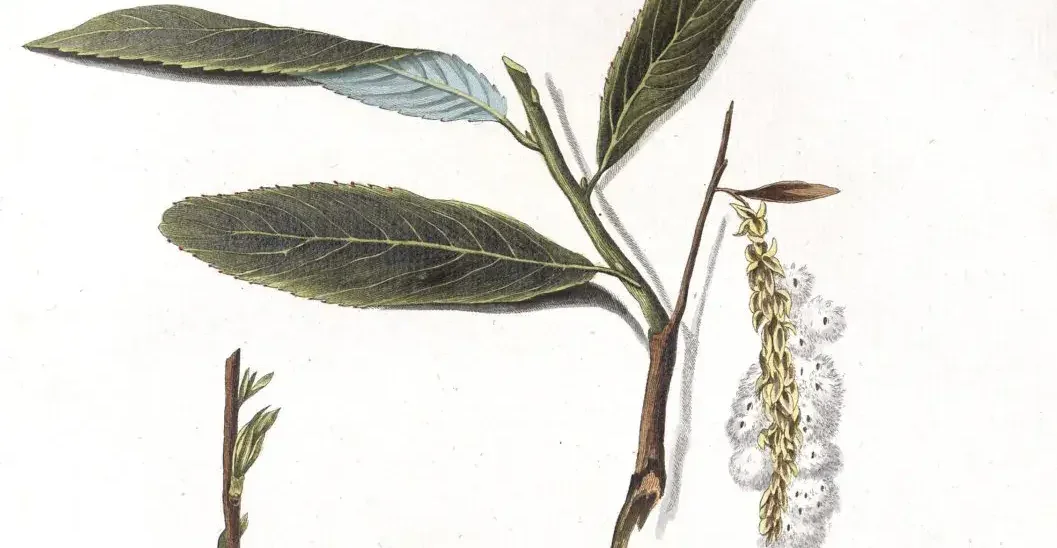
Image Salix alba by Johann Daniel Reitter; Gottlieb Friedrich Abel