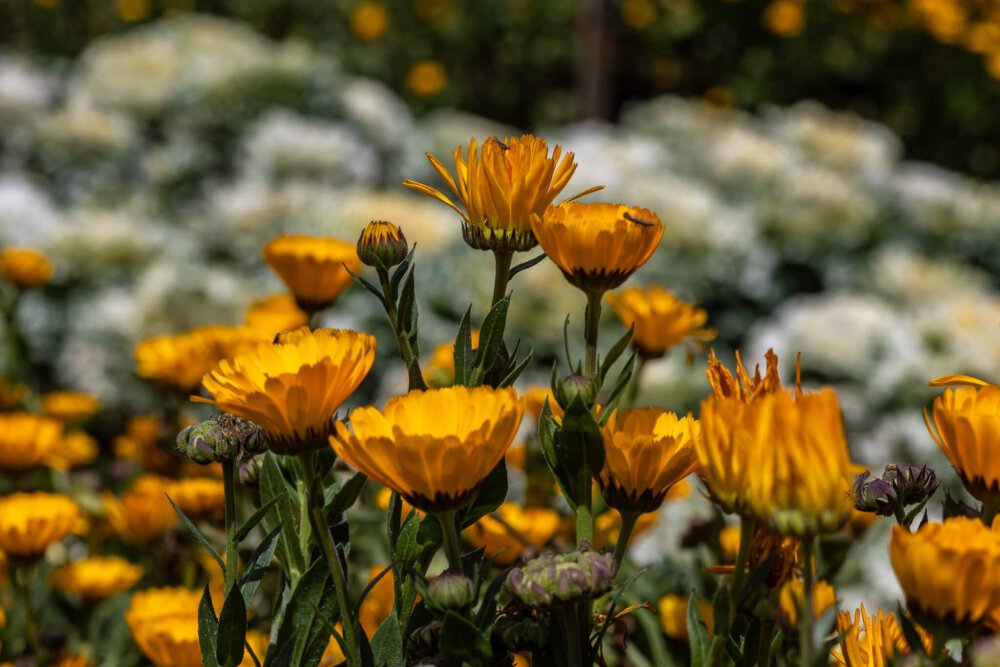
Pot marigold, or calendula (Calendula officinalis) is considered as one of the most important and versatile herbal remedies1. The combination of its actions make it a particularly effective and widely used skin calmer and wound and tissue healer2,3.
The bright orange (sometimes yellow) flowers have a light, mildly spicy taste, and traditionally this is seen as a cooling, drying herb that has a gentle astringent, tightening effect on tissue4,5,6.
Calendula’s skin benefits come from a rich mix of constituents working together. Triterpene alcohols act directly on inflamed skin, calming redness and irritation7, while flavonoids support tissue repair8,9 and essential oils help keep microbes in check10,11. In combination, these form calendula’s multiple skin-helpful actions: anti-inflammatory, antimicrobial, antifungal, astringent and mildly pain-relieving, alongside a gentle wound-healing action2,3,4.
Calendula can be used externally and internally together if necessary, and it also improves lymphatic function, aiding any inflammatory condition6. It is a traditional treatment for eczema, itching, cuts and grazes, burns, bites and stings, cradle cap, chilblains, acne, boils and nappy rash3,6,12. It is safe enough to use in an infused oil to soothe sore, cracked nipples during breastfeeding.
For external use, infusions are best for abraded skin, but a stronger 90% alcohol tincture that draws out the resin-rich compounds make it especially useful for cleaning bites, stings, fungal rashes and infected wounds. Milder tinctures or teas are generally used internally3,6.
Calendula should be used with care on septic wounds due to its rapid tissue healing action that can trap infection13. It should be avoided in cases of daisy (Asteraceae) family allergy. As with most herbs, calendula should only be administered during pregnancy or lactation with professional supervision3,4.
References
- Bartram T. Bartram’s encyclopedia of herbal medicine. Robinson; 1998.
- Bokelmann JM. Medicinal herbs in primary care. Amsterdam: Elsevier; 2022.
- Fisher C. Materia medica of western herbs. London: Aeon Books; 2018.
- Thomsen M. The phytotherapy desk reference. 6th ed. London: Aeon Books; 2022.
- Easley T, Horne S. The modern herbal dispensatory. North Atlantic Books; 2016.
- Hedley C, Shaw N. Plant medicine. Waddell G, editor. London: Aeon Books; 2023.
- Ralph A, Tassell M. Native healers. London: Aeon Books; 2020.
- Giostri GS, Novak EM, Buzzi M, Guarita-Souza LC. Treatment of acute wounds in hand with Calendula officinalis L.: a randomized trial. Tissue Barriers. 2022;10(3):1994822.
- Shahane K, Kshirsagar M, Tambe S, Jain D, Rout S, Ferreira MKM, et al. An updated review on the multifaceted therapeutic potential of Calendula officinalis L. Pharmaceuticals (Basel). 2023;16(4):611.
- Gou J, Lu Y, Xie M, Tang X, Chen L, Zhao J, et al. Antimicrobial activity in Asteraceae: the selected genera characterization and against multidrug resistance bacteria. Heliyon. 2023;9(4):e14985.
- Jyotisree G, Sruthi R, C RB, Amita SM. Calendula officinalis and Echinacea purpurea as antimicrobial agent. J Appl Pharm Res. 2020;8(2):8-12.
- Alfs M. 300 herbs: their indications and their contraindications. London: Aeon Books; 2022.
- Holmes P. The energetics of western herbs. 4th ed. London: Aeon Books; 2020.
Image: Calendula officinalis Mhlayson, CC BY-SA 4.0, via Wikimedia Commons