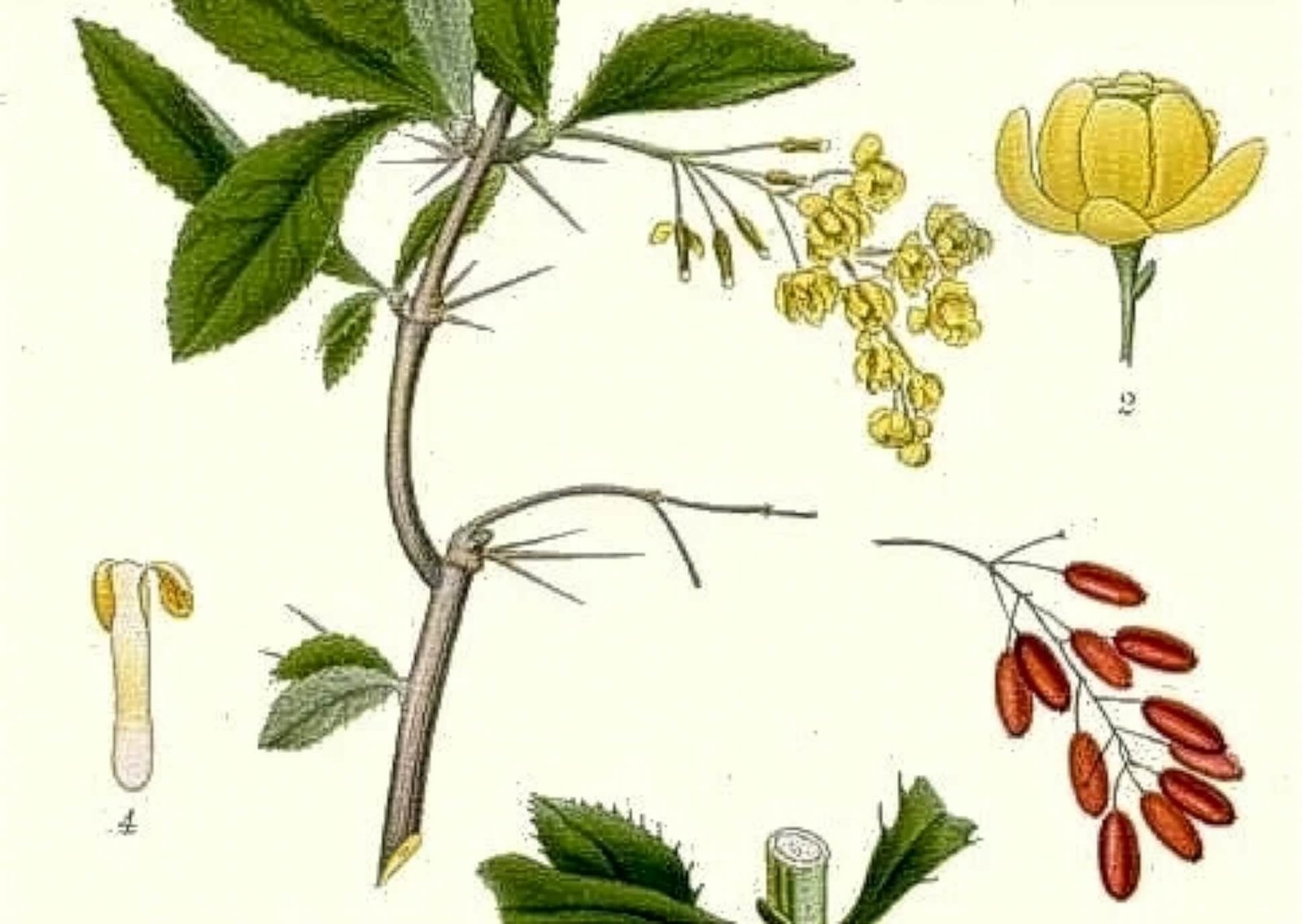
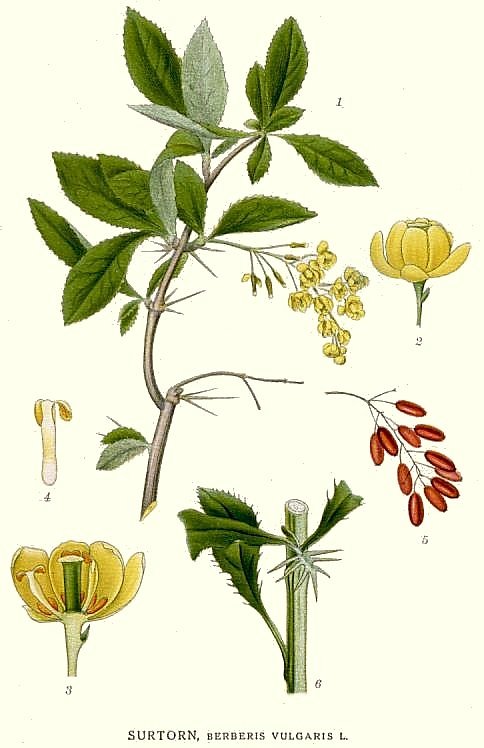
Barberry (Berberis vulgaris) is a thorny deciduous shrub with yellow flowers and edible, sharply acidic red berries. It has been known as a medicine for over 3000 years1, and it has a strong, very beneficial effect on the whole digestive system2.
The herb’s bitter, acrid taste, is a clue to its action: in herbal medicine, bitter properties stimulate digestive secretions. Barberry acts as what herbalists call a cholagogue, promoting bile flow from the gallbladder, and can help correct sluggish liver function and treat liver infections, making it traditionally indicated in conditions such as gallbladder inflammation (cholecystitis) and jaundice3.
Much of this activity comes down to berberine, the main alkaloid constituent (present at up to 6% in the bark)3,4. Berberine is a strong antibacterial, amoebicidal, antifungal and anti-inflammatory used for digestive healing, ulcers, GI spasms, irritable bowel syndrome (IBS) and peptic ulcers2,5.
Barberry is effective against gut pathogens and parasites. It inhibits endotoxins, supports healthy gut flora, and has demonstrated activity against E. coli, Giardia, amoebic dysentery, Blastocystis hominis and Dientamoeba fragilis6. This makes barberry potentially helpful for people with recurrent gut infections or a history of antibiotic-disrupted microbiomes.
Recent cancer research has found that barberry bark extract shows antiproliferative activity in tumour cells7, and root extract studies demonstrated chemo-preventive potential in colorectal cancer through anti-inflammatory, and antioxidant mechanisms1.
Barberry is not a herb to use casually or indefinitely. It is contraindicated in pregnancy and breastfeeding/nursing8; should be avoided in various conditions including intestinal spasm9. Long-term use beyond four to six weeks is not recommended8. It also interacts with certain antibiotics and antifungals9,10.
However, when used appropriately, barberry is a versatile digestive herb — bitter, anti-inflammatory, antibacterial, and hepatoprotective — with a growing evidence base supporting potential applications beyond its traditional uses.
References
- Och A, Lemieszek MK, Cieśla M, Jedrejek D, Kozłowska A, Pawelec S, et al. Berberis vulgaris L. root extract as a multi-target chemopreventive agent against colon cancer causing apoptosis in human colon adenocarcinoma cell lines. Int J Mol Sci. 2024;25(9):4786.
- Chevallier A. Encyclopedia of herbal medicine. Dorling Kindersley; 2016.
- Fisher C. Materia medica of western herbs. Aeon Books; 2018.
- Hoffmann D. Medical herbalism. Healing Arts Press; 2003.
- Hedley C, Shaw N, Waddell G. Plant medicine. Aeon Books; 2022.
- McIntyre A. The complete herbal tutor. Aeon Books; 2019.
- Ivan IM, Olaru OT, Popovici V, Chițescu CL, Popescu L, Luță EA, et al. Antioxidant and cytotoxic properties of Berberis vulgaris (L.) stem bark dry extract. Molecules. 2024;29(9):2053.
- Alfs M. 300 herbs: their indications and their contraindications. Aeon Books; 2022.
- Thomsen M. The phytotherapy desk reference. 6th ed. Aeon Books; 2022.
- Gaby A. A–Z guide to drug-herb-vitamin interactions. Harmony; 2006.
Image: Carl Axel Magnus Lindman, Public domain, via Wikimedia Commons
https://commons.wikimedia.org/wiki/File:180_Berberis_vulgaris.jpg
