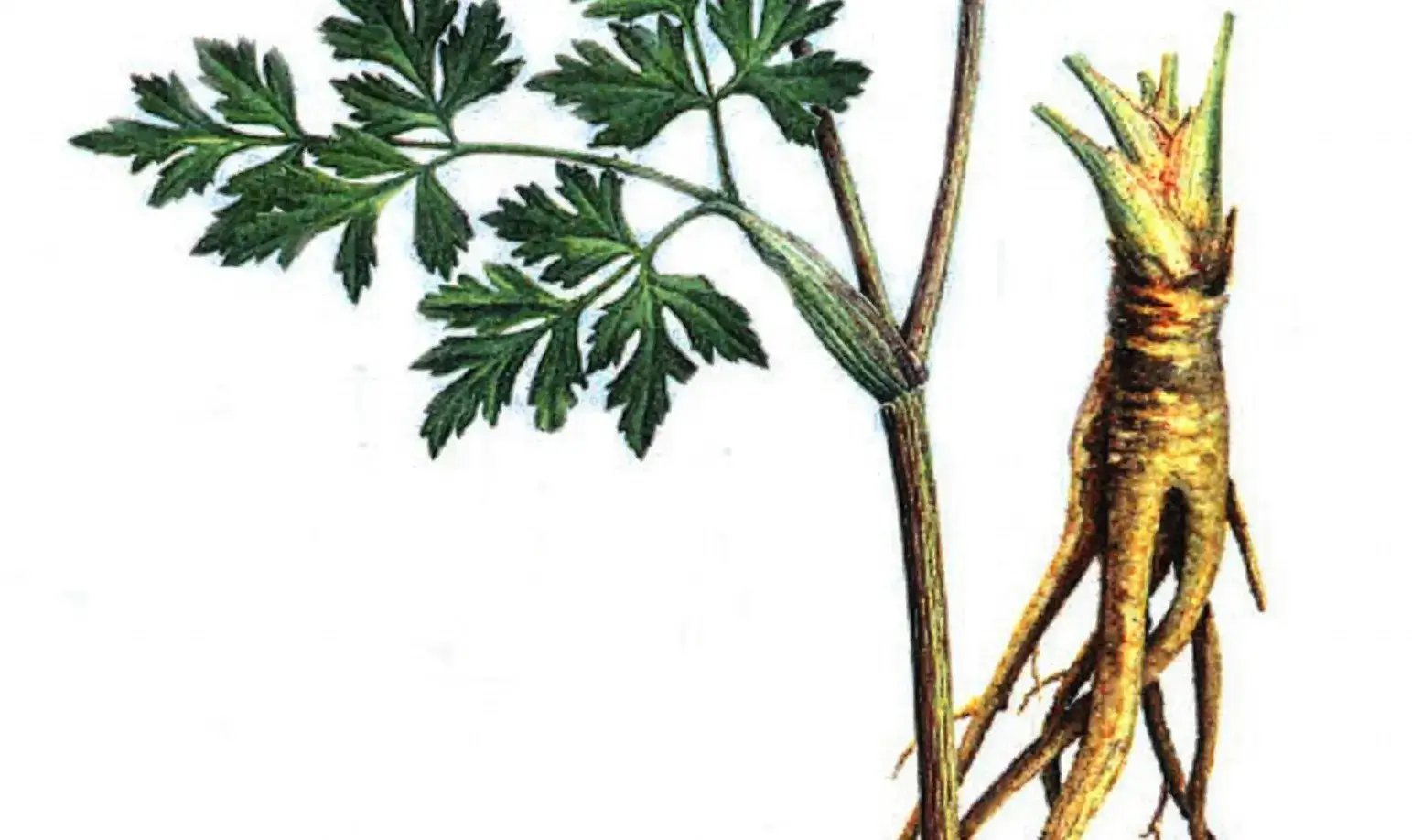
Angelica sinensis (dong quai) is a warming, sweetish root with an earthy, faintly bitter taste. It is a key herb in women’s herbal care and it has been called the ‘female ginseng’1.
A. sinensis is often taken as a a blood tonic and its polysaccharides play a role in its blood-enriching effect2,3. It also acts as a hormone regulator4, helping bring rhythm back to erratic menstrual cycles. Its Chinese name, dang gui, translates as ‘state of return’, relating to its ability to return someone to health5.
A. sinensis is commonly used to relieve painful periods and support fertility6, and it combines well with Paeonia lactiflora for menstrual pain7. There is also some research evidence pointing to benefits for polyendocrine metabolic ovarian syndrome (PMOS), previously known as polycystic ovary syndrome (PCOS)8,9.
Different parts of the root seem to have different actions: the head, anticoagulation; the main root, tonic and pain relief; the tail, ‘blood stasis’ elimination10. Also, the uterus-stimulating compounds are water soluble (not available via tincture); while the uterus-relaxing essential oils are alcohol-soluble and only available via tincture11.
A. sinensis also has broader rreproductive actions: for example, ferulic acid in the root has been shown to improve sperm motility and viability, and also support healthy microcirculation10,11.
As is often the case, there are a number of cautions and contraindications associated with taking A. sinensis. It is best avoided in pregnancy and lactation, and by anyone with heavy menstrual bleeding or a bleeding disorder. Care is also advised if taking alongside blood-thinning medication.
References
- Bartram T. Bartram’s encyclopedia of herbal medicine. Robinson; 1998.
- Chevallier A. Encyclopedia of herbal medicine. Dorling Kindersley; 2016.
- Tian Y, Shen X, Hu T, Liang Z, Ding Y, Dai H, et al. Structural analysis and blood-enriching effects comparison based on biological potency of Angelica sinensis polysaccharides. Front Pharmacol. 2024;15:1405342.
- Williamson EM. Potter’s herbal cyclopaedia. The C.W. Daniel Company; 2003.
- McIntyre A. The complete herbal tutor. Aeon Books; 2019.
- Bone K, Mills S. Principles and practice of phytotherapy. 2nd ed. Elsevier Health Sciences; 2013.
- Hedley C, Shaw N. Plant medicine. Aeon Books; 2022.
- Gao Y, Mo S, Cao H, Zhi Y, Ma X, Huang Z, et al. The efficacy and mechanism of Angelica sinensis (Oliv.) Diels root aqueous extract based on RNA sequencing and 16S rDNA sequencing in alleviating polycystic ovary syndrome. Phytomedicine. 2023;120:155013.
- Zeng LH, Rana S, Hussain L, Asif M, Mehmood MH, Imran I, et al. Polycystic ovary syndrome: a disorder of reproductive age, its pathogenesis, and a discussion on the emerging role of herbal remedies. Front Pharmacol. 2022;13:874914.
- Balch PA, Bell S. Prescription for herbal healing. 2nd ed. Penguin; 2012.
- Brice-Ytsma H, Chidley N. Herbal medicine in treating gynaecological conditions: volume 2. Aeon Books; 2024.
Image: Angelica sinensis. Creative Commons.