
The Mediterranean diet is often touted as a healthy ideal: olive oil, vegetables, fish, and long meals shared with family. Indeed, it is one of the most widely researched dietary patterns, attributed to physiologist Ancel Keys, who studied mid-twentieth-century eating habits in southern Italy, Crete, and Greece1. UNESCO has since recognised it as an Intangible Cultural Heritage of Humanity, a status now extended to Croatia, Cyprus, Spain, Morocco, and Portugal2.
The benefits
Despite being relatively high in fat, mostly from olive oil, the diet is consistently linked to improved cognitive function and a reduced risk of diabetes, metabolic syndrome, obesity, cardiovascular disease, and certain cancers1. One attempt to standardise the pattern suggested daily servings of three to nine portions of vegetables and up to eight of olive oil, delivering around 2,220 kilocalories3, with notably higher fibre than typical Western diets4. It’s also associated with more favourable blood lipids, lower inflammation, and better blood pressure, without the weight gain often feared from a higher-fat diet1. The unhurried, shared style of eating that goes with it may itself be an underrated part of the benefit5. Beyond the plate, research points to gut microbiome benefits7, protection against micronutrient deficiencies6, and improvements in inflammation and quality of life8.
The limitations
The diet’s popularity partly rests on strong branding, and the science underneath is less tidy than it looks. Researchers have struggled to agree on a single definition, which makes comparing studies difficult3,4. Sourcing genuine Mediterranean staples can also be costly: olive oil prices roughly doubled between 2022 and early 20249. Some of the most influential evidence has come under scrutiny too. The landmark PREDIMED trial, once used to support major cardiovascular claims, was retracted and republished in 2015 after protocol deviations came to light, yet it continued shaping public understanding for years afterwards10. A more recent review linking the diet to reduced cardiovascular risk in women was later criticised for inadequate statistical adjustment11.
Concluding thoughts
As with any popular eating pattern, it is worth separating the well-supported basics from the more optimistic headlines built on shakier foundations. Indeed, the Mediterranean diet, like most others, is a construct of ideas and themes from a particular place and/ or time, mainly based on based on local necessity. However, the diet’s core principles – plenty of plants, healthy fats, minimal processed food, and eating as a social act – remain sound, evidence-backed advice.
Perhaps the best lesson is the principles behind it, rather than strict adherence to the diet itself: eat locally and in season, enjoy eating, eat as wide a variety of foods as possible (not eating anything to excess); but also eat based on individual ability to process what is being consumed.
References
- Guasch-Ferré M, Willett WC. The Mediterranean diet and health: a comprehensive overview. J Intern Med. 2021;290(3):549-566.
- United Nations Educational, Scientific and Cultural Organization. The Mediterranean diet [Internet]. UNESCO; 2022 [cited 2026 Jul 20]. Available from: https://mediterraneandietunesco.org/
- Davis C, Bryan J, Hodgson J, Murphy K. Definition of the Mediterranean diet: a literature review. Nutrients. 2015;7(11):9139-9153.
- Barber TM, Kabisch S, Pfeiffer AFH, Weickert MO. The effects of the Mediterranean diet on health and gut microbiota. Nutrients. 2023;15(9):2150.
- Godos J, Scazzina F, Paternò Castello C, Giampieri F, Quiles JL, Briones Urbano M, et al. Underrated aspects of a true Mediterranean diet: understanding traditional features for worldwide application of a “Planeterranean” diet. J Transl Med. 2024;22(1):294.
- Castro-Quezada I, Román-Viñas B, Serra-Majem L. The Mediterranean diet and nutritional adequacy: a review. Nutrients. 2014;6(1):231-248.
- Khavandegar A, Heidarzadeh A, Angoorani P, Hasani-Ranjbar S, Ejtahed HS, Larijani B, et al. Adherence to the Mediterranean diet can beneficially affect the gut microbiota composition: a systematic review. BMC Med Genomics. 2024;17(1):91.
- Baliou S, Ioannou P, Apetroaei MM, Vakonaki E, Fragkiadaki P, Kirithras E, et al. The impact of the Mediterranean diet on telomere biology: implications for disease management – a narrative review. Nutrients. 2024;16(15):2525.
- Holland K. Price declines and market dynamics: analysing the current olive oil landscape [Internet]. Mintec; 2024 [cited 2026 Jul 20]. Available from: https://www.mintecglobal.com/top-stories/price-declines-and-market-dynamics-analysing-the-current-olive-oil-landscape
- Agarwal A, Ioannidis JPA. PREDIMED trial of Mediterranean diet: retracted, republished, still trusted? BMJ. 2019;364:l341.
- Pant A, Gribbin S, McIntyre D, Trivedi R, Marschner S, Laranjo L, et al. Primary prevention of cardiovascular disease in women with a Mediterranean diet: systematic review and meta-analysis. Heart. 2023;109(16):1208-1215.
Images:
Mediterranean foods: G.steph.rocket – Own work, CC BY-SA 4.0
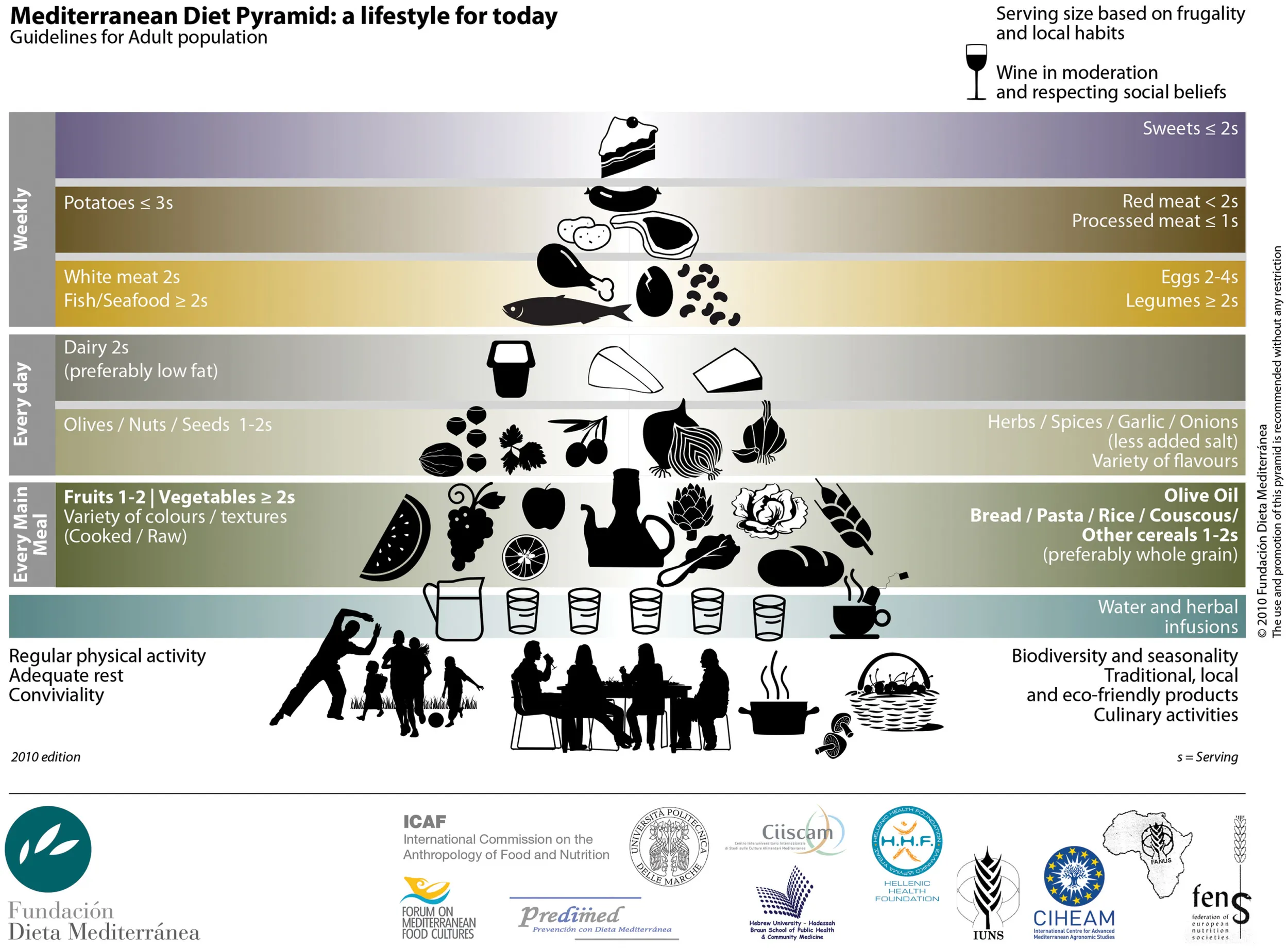
Mediterranean diet pyramid: Science and cultural updates. Public Health Nutr (2011) 14(12A):2274–84.10.1017/S1368980011002515